You've probably heard this before:
I have a website, yet I get almost no inquiries.
It's one of the most common remarks we hear during our audits. And it's perfectly understandable.
For a long time, having a website was enough to stand out. Today, it's no longer the case. The internet has changed, Google has changed and consumer habits too. A website is still essential, but it's no longer the final destination. It has become the starting point of a visibility ecosystem.
Why is a website no longer enough?
A few years ago, the number of competing sites was limited. Today, almost every business has a website. For Google, having a site is therefore no longer a differentiator.
The real question is now:
Why should it show yours before a competitor's?
To answer, Google analyzes hundreds of signals. It tries to determine which business will give the internet user the best answer. Your site is only one of those signals, and its ranking rests on five main criteria.
What is Google really looking for?
Google isn't trying to find the prettiest site. It's looking for the one that inspires the most trust and best answers a search intent. For that, it evaluates in particular:
- the quality of your content;
- your expertise in your field;
- your local presence;
- your Google Business Profile;
- your customer reviews;
- your site's technical performance;
- the consistency of your information across the web;
- the links pointing to your business;
- the structure of your pages;
- the structured data that helps its algorithms understand your business.
In other words, your site is a piece of a much larger puzzle.
What a website does, and what it doesn't
A well-built site fulfills several essential functions. It presents your business, it reassures your visitors, it answers the first questions and it lets people get in touch.
However, a site doesn't guarantee that people find it. It's a bit like opening a shop on a street where no one walks by. Your window can be beautiful, but if no one knows it exists, it stays empty.
Why do some businesses get inquiries every week?
It's usually not because they have a better site. It's because they built a complete visibility system. That system rests on several pillars that work together.
| A simple site | A visibility system |
|---|---|
| Presents the business | Attracts qualified visitors |
| Waits to be found | Creates visibility opportunities |
| Little content | Answers prospects' questions |
| Few trust signals | Multiplies proof of credibility |
| Works alone | Works with Google, Google Maps and AI |
The difference is considerable. Some businesses even get inquiries every week without any advertising.
Customer habits have changed
Before contacting a business, a prospect often makes several checks. They look at the site, they read the reviews, they compare several businesses, they check Google Maps and they may even ask a question to ChatGPT or another AI assistant.
Each touchpoint influences their decision. Your visibility therefore no longer depends solely on your site. It depends on your entire digital presence.
Search engines are no longer alone
For a long time, Google was the only gateway to the internet. Today, habits are evolving. Many people now ask directly:
- What's the best lawyer in Lyon?
- Which tradesperson do you recommend near me?
- Which coach should I choose for my project?
These questions are now asked to ChatGPT, Gemini, Claude or Perplexity. These assistants don't pick a business at random. They favor businesses whose information is clear, consistent and widely recognized across the web. In other words, the work done for Google also benefits your visibility in AI-powered engines.
The elements that really make the difference
When a business improves sustainably on Google, it's almost never thanks to a single action. It's the accumulation of many positive signals. Among the most important:
- a fast, mobile-friendly site;
- an optimized Google Business Profile;
- recent, authentic customer reviews;
- content that answers prospects' questions;
- good internal linking between pages;
- Schema.org structured data;
- a consistent identity across all directories;
- a regular editorial strategy;
- links from reliable sites.
Each element strengthens the others.
Visibility has become a system
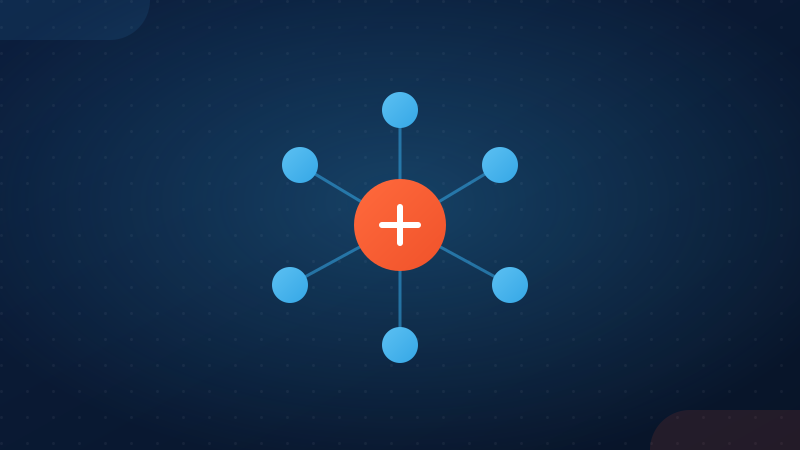
Picture your visibility as a wheel. The site is the hub. Around it spin several spokes:
- organic SEO;
- local SEO;
- Google Business Profile;
- customer reviews;
- your blog content;
- structured data;
- your reputation;
- your presence in AI answers.
If one or more spokes are missing, the wheel keeps turning, but far less effectively.
Why we created Click First™
At Monsieur Click, we saw that many businesses invested in a site without getting the results they hoped for. Not because their site was bad, but because it worked alone.
It's precisely to address this reality that we designed Click First™. Rather than stacking independent services, we bring together the main visibility levers in one coherent method.
The goal isn't just to build a pretty site. The goal is to build a system that helps your business get found on Google, Google Maps and in AI answers, then convince your future customers to choose you.
The questions you should ask yourself
Instead of asking "Do I have a website?", ask yourself these questions:
- Is my business visible when a prospect searches for my services?
- Does Google clearly understand my business?
- Does my content answer my future customers' questions?
- Do I have enough proof of trust?
- Am I also visible in AI answers?
If the answer is no to several of these, it's probably not your site that's the problem. It's your visibility system.
In one sentence
A site is the hub, not the wheel. It's the whole set of spokes, connected by a method, that brings in customers.