

The essentials in 30 seconds
- Generative engine optimization (GEO) is the art of making your business clear to AI, so it can cite it in its answers.
- For Google, GEO rests first on good SEO: its AI answers draw on its own index.
- Almost half of people in France already use generative AI, and many ask it which business to choose.
- What really helps: first-hand content, clear pages, a complete Google profile, real reviews.
- No one can guarantee a citation. But you can put every chance on your side.
- 48%of people in France use generative AI, up 15 points in one yearArcep, Digital Barometer 2026
- 45%of consumers ask an AI to recommend a local businessBrightLocal, 2026
- 8%click on a result when an AI summary appears, versus 15% withoutPew Research Center, 2025
Generative engine optimization, or GEO, means preparing your website so that assistants like ChatGPT, Gemini or Google’s AI Overviews understand your business and cite it in their answers. Good news: Google explains in its official guide that its AI answers rely on its usual ranking systems. In other words, GEO is not separate magic. It is the continuation of good SEO, with a few extra habits.
If you feel like everything is moving too fast, don’t worry: that’s normal. The vocabulary changes every six months, and so do the promises. Here, we’ll stay practical. What works, what is useless, and what we have seen with our own eyes.
What is generative engine optimization (GEO)?
Generative engine optimization covers everything that helps an AI understand your content, trust it and reuse it in an answer. Where classic SEO aims for a spot in a list of links, GEO aims for a spot in the answer itself.
Imagine a customer asking: “Which reliable plumber is there near Montrouge?” They used to get ten links. Today, they often get a short text that cites two or three businesses. GEO is all the work that makes you “citable” in that exact spot.
Where does the word GEO come from?
The term comes from a Princeton study presented in 2024. Its authors tested thousands of queries on generative engines. Their finding: adding cited sources, quotations and statistics can increase a piece of content’s visibility by up to 40%.
The same work also shows the opposite. Keyword stuffing, an old recipe from the 2000s, does worse than doing nothing at all. AI prefers a clear, well-supported text to one that repeats the same phrase twenty times.
GEO, SEO, AEO: three names, one foundation
You will also read AEO (Answer Engine Optimization) or LLMO. Don’t be put off by the acronyms. Google itself puts these terms in the same family: to appear in its AI answers, you first need to follow SEO best practices. That is rather reassuring. The work done for Google also serves AI.
Why does GEO matter for a local business?
GEO matters because your future customers increasingly ask an AI their questions before choosing a business. And when the AI answers, it only cites a handful of names.
Your customers ask AI their questions
In France, 48% of the population already uses generative AI, up 15 points in one year. ChatGPT remains the main tool for almost two users out of three.
For shops and services, the shift is even clearer. According to BrightLocal, 45% of consumers now use an AI to find a local business, versus 6% a year earlier. It is no longer a geek curiosity. It is a new habit.
Being cited beats being ranked below
When an AI summary appears, people click less on classic links. A Pew Research study measured 8% of clicks on a result when an AI summary is present, versus 15% without one. Questions phrased as full sentences also trigger these summaries more often.
The conclusion is simple. If your business appears in the answer, you are seen. If it is only ranked below, you risk going unnoticed.
What we have seen after redesigning certain pages
Let’s talk about what we have seen in the field, at Monsieur Click. After redesigning certain pages, our clients’ articles and websites were cited by AI. And the rankings of those websites on Google moved.
What changed on those pages
We carried out a global optimization, not an isolated tweak:
- complete structured data, describing the business, its services and its contact details;
- OKF and llms.txt files, to summarize the business for AI assistants;
- title tags and meta descriptions rewritten, page by page.
Let’s be honest: we cannot say which of these levers mattered most. We saw an overall effect. That is precisely why we work on every lever at the same time, rather than one alone while hoping for a miracle.
Why it works, according to Google
Google insists on one point: the content that performs best brings a unique perspective, grounded in real experience. It talks about “non-commodity” content. A clear, precise page that is consistent with the rest of the web is easier to understand, and therefore easier to cite. Our redesigns went in that direction: saying clearly who does what, where and how.
How do you do generative engine optimization for your business?

Doing generative engine optimization means first taking care of four things: your content, your website’s structure, your Google profile and your reviews. Here is how we approach them, without jargon.
Content drawn from your experience, not a summary of the web
Google says it plainly in its advice on helpful content: it favors pages written for people, with real expertise. A copied “top 10 tips” doesn’t set you apart from anyone.
Instead, share what only you know. The questions your customers ask you. The mistakes you often see. The way you work. That is the kind of content an AI wants to reuse, because it can’t find it anywhere else.
Clear pages, readable by Google and by AI
An AI doesn’t guess. It reads. Google’s page on AI features recalls a few basics that change everything: important content written as text, internal links so every page can be found, a good mobile experience, and structured data that matches the visible text.
Let AI crawlers read your website
If crawlers can’t get in, no one will cite you. OpenAI describes its own crawlers, including OAI-SearchBot for ChatGPT search, in its technical documentation. During our audits, we check that your robots.txt file doesn’t block them by mistake. It happens more often than you’d think, and it’s a bit like locking the shop on the first day of the sales.
The same information everywhere
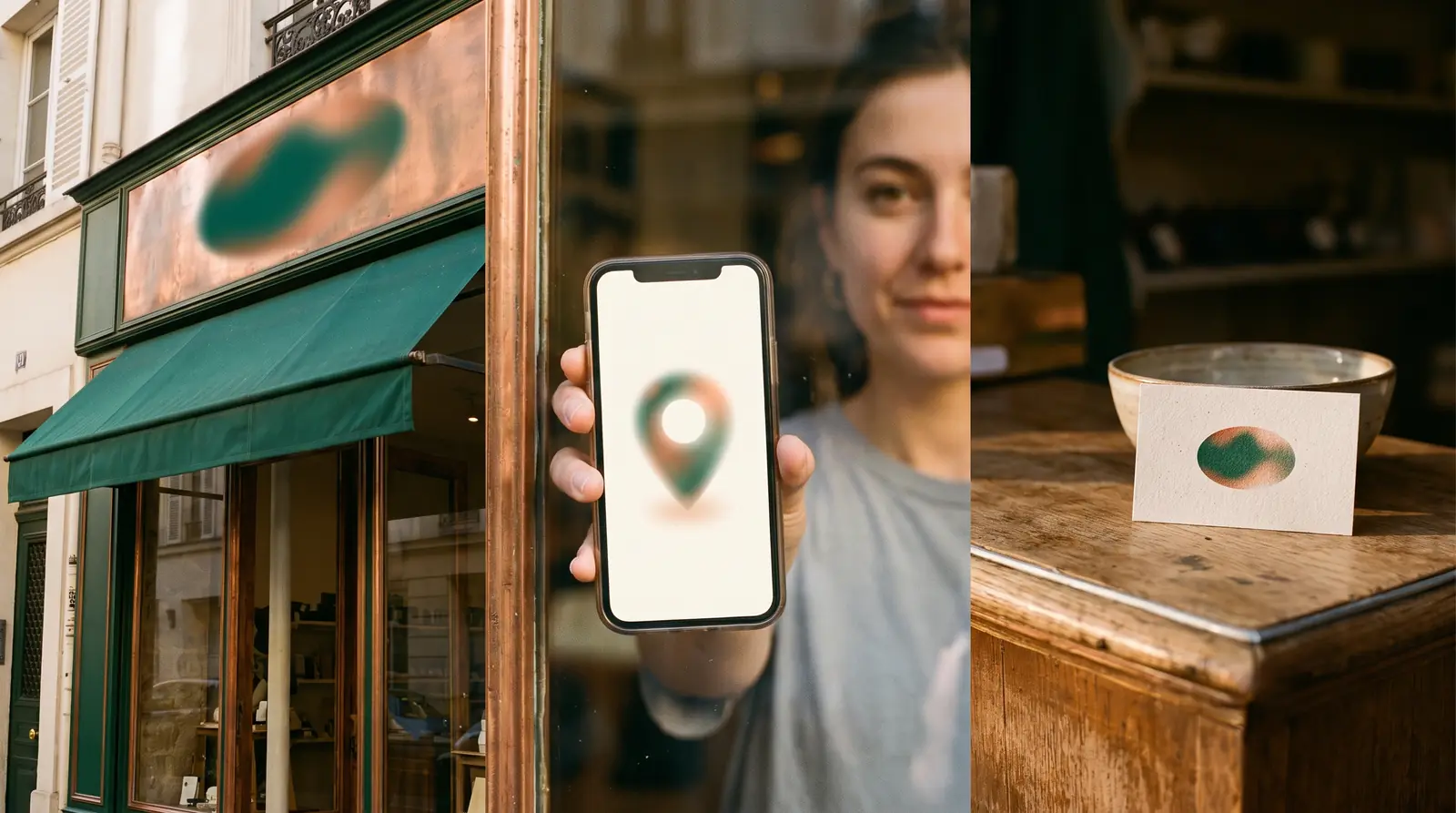
Your name, address and phone number must be the same on your website, your profile and directories. This is called NAP consistency. It is one of the pillars of our local SEO work. An AI that finds three different addresses for the same business hesitates. And an AI that hesitates doesn’t cite.
A complete, up-to-date Google profile
For local searches, Google also draws on business details. Opening hours, services, service area, photos: every box you fill in helps AI answers talk about you correctly. A half-empty profile is a business card with half the phone number rubbed out.
Real, recent reviews
Reviews reassure your customers, and they also feed AI. Be careful: people check. According to the same BrightLocal survey, 88% of consumers check the reviews cited by an AI. Hence our rule: only genuine reviews, requested at the right moment. We detail this method on our Google reviews page.
Do llms.txt and OKF files really help?
The llms.txt file and OKF can help some AI assistants, but Google states that it doesn’t use them for its search engine. It is written in black and white in its guide: no special files are needed to appear in Google, AI included.
So why do we set them up? Because Google is not the only assistant on the market. These files summarize your business in a simple format, for the tools that choose to read them. We see them as a preparation bonus, never as the priority, and never as a guarantee. The priority remains content, structure and your profile.
False good ideas to avoid
GEO attracts its share of miracle “hacks”. Google debunks several in its guide:
- chopping your text into small pieces to “please the AI”: useless, Google understands a whole page
- rewriting your pages specifically for AI it understands synonyms and overall meaning
- manufacturing fake mentions of your brand across the web: anti-spam systems are watching
- multiplying near-identical pages for every search variant: this is considered mass-produced content.
And as the Princeton study showed, keyword stuffing actually lowers visibility. In short, shortcuts cost more than they bring in.
How do you know whether AI cites you?
The simplest way is to look at the new “Generative AI” report in Search Console, then test the assistants yourself. Google opened this performance report to all websites at the end of August 2026. It shows how many times your pages appear in its AI answers.
For ChatGPT or Perplexity, nothing beats a practical test: ask the questions your customers ask, and see who gets cited. That is exactly what we do during the diagnostic. Then we track these appearances in the monthly report.
Can you guarantee being cited by ChatGPT?
No, no one can guarantee being cited by ChatGPT, Gemini or Google. AI decides on its own, and its rules change without warning. Be wary of anyone who promises otherwise.
What we can do is work on everything that depends on you: first-hand content, clear pages, consistent information, a complete profile and real reviews. Then we measure, adjust and start again. It is less spectacular than a promise, but much more solid.
Our approach to GEO at Monsieur Click
At Monsieur Click, GEO is part of a broader system: the Click First™ method. Your website, your local SEO, your Google profile, your reviews and your AI visibility are built around the same information. That is what makes your business easy to understand, for Google and for AI.
The free diagnostic
It all starts with 30 minutes, with no commitment. We listen to your business, then look at your real visibility: Google, Google Maps, your profile, your reviews, your website’s technical health and your presence in AI. You leave with your three priorities.
A written plan, then monthly follow-up
If you wish, you receive a written proposal within 48 hours: what we would do, in what order, how long it would take and for what budget. Then a monthly report shows you what is improving: Google and Google Maps rankings, traffic, reviews and appearances in AI engines.
Want to know what AI says about your business today? Let’s start there. As an SEO agency based in Malakoff, just outside Paris, we take stock with you, remotely, in thirty minutes.
The sites we deliver are prepared for that from the first version: see our work.
Article written from our field experience and verified sources. No ranking or AI citation is guaranteed.
 ChatGPT SEO: how to show up in ChatGPT, Gemini and Perplexity
 Finding a business with ChatGPT: your customers’ new habit
 Will ChatGPT replace Google? What it changes for your business